🤖 The Robot in Your Garden
How to choose the right robotic mower for your lawn
Imagine this: it’s a sunny Saturday morning. You’re enjoying a coffee on your patio while, quietly in the background, a small robot is taking care of your lawn. No noise, no effort — just perfectly cut grass.
Sounds ideal, right? It is.
But here’s the catch: not every robotic mower fits every garden.
The real question isn’t “which robot is best?”
It’s: “which robot works in your garden?”
Let’s break it down into three common garden types.
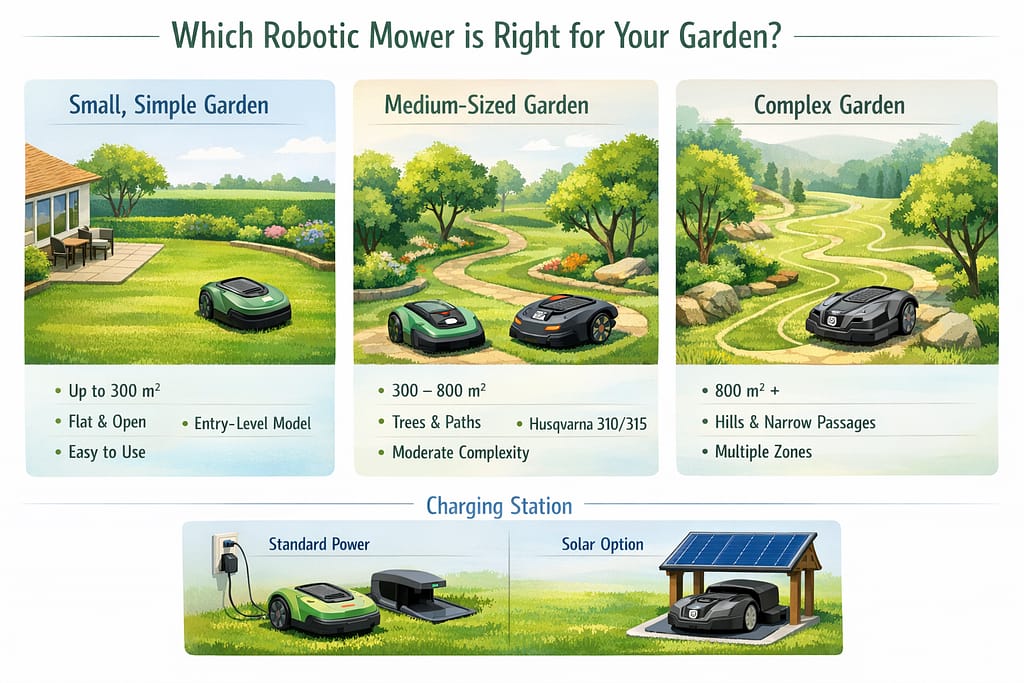
🌱 1. The Small, Simple Garden
The perfect entry point
Typical features:
- Up to 300 m²
- Simple shape (rectangular or open)
- Few or no obstacles
- Flat terrain
🤖 Best fit:
Entry-level models like the Bosch Indego S series
Why it works:
- Systematic mowing (clean, straight lines)
- Easy setup
- Budget-friendly
- Visually neat results
The experience:
It feels structured and efficient — almost like someone carefully mowed it for you.
👉 Conclusion:
Perfect if you want convenience without complexity.
🌿 2. The Medium-Sized Garden
Where things get interesting
Typical features:
- 300–800 m²
- Curves, trees, flower beds
- Possibly narrow passages
🤖 Best fit:
Bosch Indego M → user-friendly & structured
Husqvarna 310/315 → flexible & robust
Key difference:
- Bosch = neat mowing pattern
- Husqvarna = better at handling tricky layouts
The experience:
Your robot starts to “think” — navigating zones, obstacles, and routes.
👉 Conclusion:
Most gardens fall into this category. Choose based on ease of use vs. reliability.
🌳 3. The Complex Garden
Where robots are truly tested
Typical features:
- 800 m²+
- Trees, shade, uneven terrain
- Narrow passages
- Multiple zones
🤖 What actually works:
Husqvarna Automower 315 Mark II
Why:
- Handles complexity with ease
- Reliable even under trees
- Uses boundary wire instead of GPS
⚠️ What about wireless (RTK) mowers?
They sound great:
- No boundary wire
- Fully app-controlled
But in complex gardens:
- GPS signal is disrupted by trees 🌳
- Navigation struggles in tight passages
- Result: inconsistency and frustration
👉 Key insight:
The more complex your garden, the more valuable a simple wire becomes.
🔌 The Unsung Hero? the Charging Station
Every robot needs a home base.
- Powered by standard electricity (outlet)
- Not solar by default
- Placement is crucial for performance
💡 Tip:
A well-placed charging station often matters more than the brand you choose.
🤔 One robot… or several?
It sounds logical: multiple zones → multiple robots.
But in reality:
- ❌ More expensive
- ❌ More maintenance
- ❌ Often unnecessary
👉 Better approach:
One high-quality robot, properly installed.
Only consider multiple robots if your lawn is physically separated (e.g. front and backyard with no connection).
⚡ Final Thoughts
The robot in your garden doesn’t need to be “the best” —
it needs to be the right match.
- Small garden → Bosch (simple & clean)
- Medium garden → Bosch or Husqvarna (preference-based)
- Complex garden → Husqvarna (reliability wins)
☕ In the End
You don’t buy a robotic mower for the technology.
You buy it for the feeling:
✔ Always a well-kept lawn
✔ Zero effort
✔ More time to enjoy your garden
And when everything is set up right…
that little robot might just become your favorite garden assistant.
Insightful reviewer GPT
Offers reviews and critiques with ratings and personalized recommendations based on user profiles.
Thank you for reading, comments and shares!
Create your own website
And learn how to monetize it

Heads up! If you’re looking to join Wealthy Affiliate, make sure you sign up using my referral link to get access to my personal coaching and all WA features."